
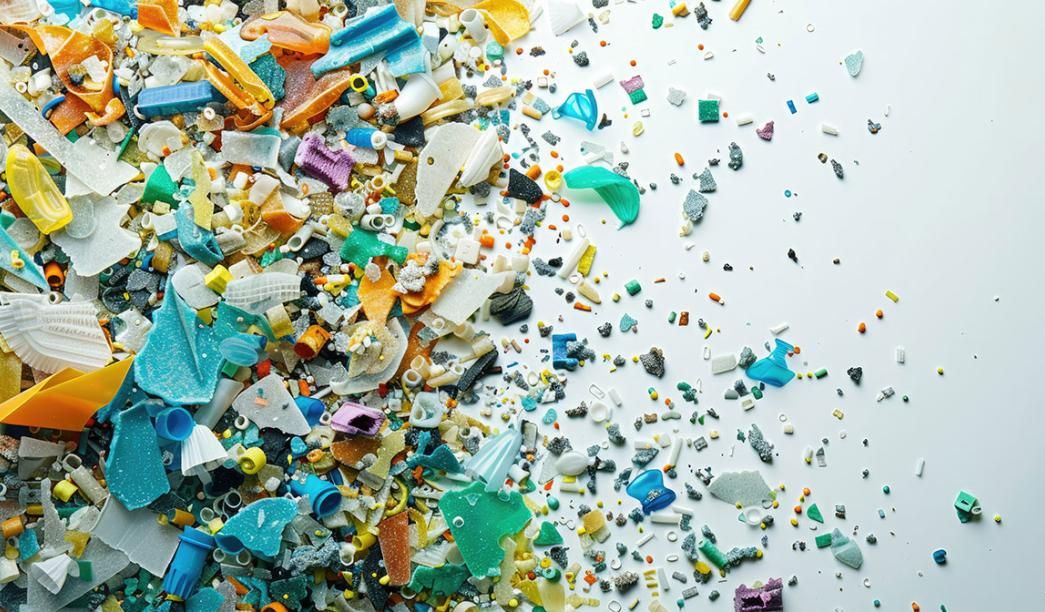
For something so small, their impact is deceptively profound.
Microplastics range in size from 1 micron to 5 millimeters (for comparison, a strand of hair measures about 50 to 100 microns in diameter, while the smallest particle visible without a microscope is about 40 microns). In recent years, they have become synonymous with the threat of a looming, largely invisible environmental health crisis that has scientists around the world sounding the alarm.
“We’re more aware of the potential harm deriving from plastic pollution,” said Cinzia Fissore, Roy E. and Marie G. Campbell Distinguished Chair in Biology and professor of environmental science. Tiny particles that enter the food chain and water supply, microplastics and their even smaller cousins, nanoplastics (which measure from 0.001 micron to 1 micron) lodge in internal organs like the brain and liver. Detected in the human bloodstream, skin tissue, and even breastmilk, they accumulate in our bodies similarly to PFAS or other “forever chemicals,” which can be present as microplastics and other industrial products break down over time. Most types of synthetic plastic can break down into these particles and persist in the environment.
Common sources of microplastics include consumer cosmetic and cleaning supplies, synthetic clothing and textiles, and some manufacturing equipment. Most glitter contains microplastics, as does household dust. Studies suggest links to cancer, heart attacks, reproductive and immune system disruptions, and a host of other medical concerns, in addition to severe ecological damage.
“We live in a coastal area, so the issue of plastic pollution in our oceans is very real to our students,” Fissore added. While there are still many unknowns, research into creative solutions is already underway. The challenge? Micro and nanoplastics have already infiltrated every corner of the planet, from Arctic permafrost to the sea floor.
“Plastic literally is everywhere,” said Christina Bauer, Chester and Olive McCloskey Endowed Chair in Chemistry and associate professor of biology and environmental science. “It’s hard to avoid.”
A few summers ago, Bauer, Fissore, and student research fellow Connor Hoemann ’23 set out to find some answers closer to home. Hoemann sampled for six types of plastic, including fibers, at four Los Angeles County estuaries: the Los Angeles River, the San Gabriel River, Malibu Creek, and the Dominguez Channel. Their partnership not only resulted in a study published in 2024 but also launched Hoemann’s career in sustainability and helped inspire Bauer’s current research focus on upcycling filtration.
The Spark
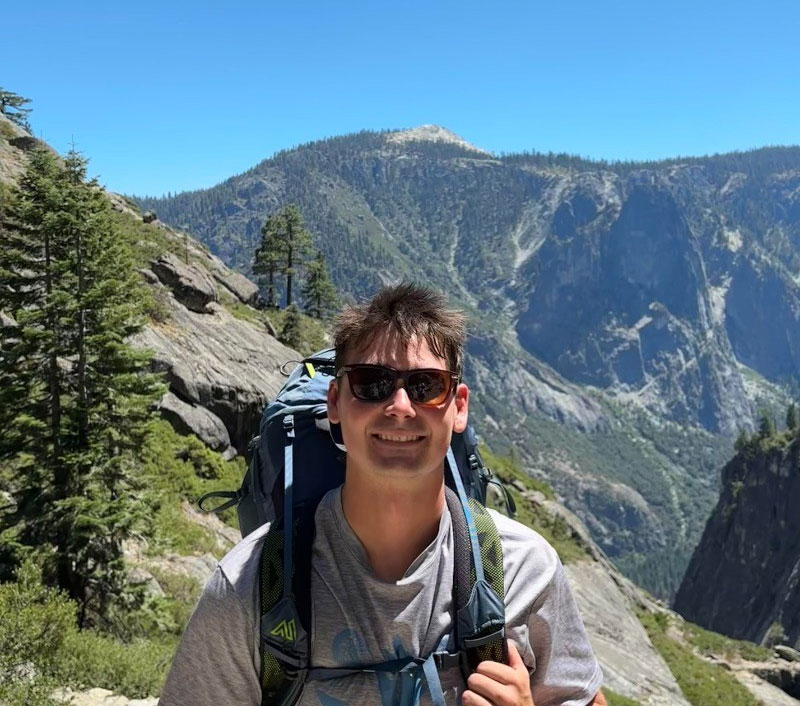 According to Hoemann, it all started with an elective on polymers and plastics. The environmental science course captured his attention and catapulted him toward his professional trajectory.
“It turned into my senior project, and that eventually led to the research grant and data collection.”
His persistence paid off: “Then I basically spent the next two months in the lab doing a deeper analysis of the microplastic samples. It was an awesome experience, and it has really helped me in my career so far.”
Hoemann now works with the Toward Zero Waste Program at Sustainable Connections, a nonprofit based in his native Bellingham, Washington. The environmental science grad still thinks about the research, which ultimately showed significant microplastic pollution at each location surveyed, even the less urbanized sites. Polyethylene and polypropylene, two of the most common plastics, dominated the samples.
“It speaks highly of how we work alongside our students to tackle real-world problems, but we also take the lead from our students,” said Fissore. “We understood that Connor had an interest in this, and he took the necessary coursework to be ready to investigate it further. This project was a continuation of what he learned in Professor Bauer’s class, and she was able to mentor him through the process.”
For Bauer, the project was notable not only for its academic rigor and data quality, but also for its origins. “It truly was Connor’s idea,” she said. “I loved how he connected the class to a real-life study that we turned into an published peer-reviewed paper.”
Shining On
It’s rare for undergraduates to coauthor studies in scientific journals, but that’s exactly what Hoemann did with support from Bauer and Fissore. Their article was published in Marine Pollution Bulletin last fall.
“We're really proud that he was involved in every step,” Fissore said. “He got to see how laborious it is to write a manuscript, how long it takes, how many rounds of edits it goes through.”
Meanwhile, Bauer is not slowing down.
“I always have five pots boiling,” she laughed. Her latest endeavor involves using charcoal from spent coffee grounds to filter PFAS and nanoparticles, another collaboration with students.
“We first developed a teaching lab experiment out of it so that students could do project-based learning,” she said. “They were getting coffee grounds, and we were charring them in inert atmospheres. We then gave students mock ‘contaminated’ water, and they were filtering it with the upcycled coffee grounds to see how effective that was. It was very effective. We realized, ‘Wow, we made something that is really working, even better than commercial charcoal.’ Right now, the coffee is proof of concept, but we are optimizing the process to tackle difficult pollutants, such as PFAS.”
This method of upcycling with granular, activated carbon may offer a solution to the high cost and unsustainability of water filtration using reverse osmosis. Mia Ventura ’27, a computer science and environmental science major from La Mirada, California, is assisting with this effort.
“I’m really interested in environmental technology that can reduce our impact on the planet,” she said. “I learned a lot about forever chemicals in Professor Bauer’s plastics and polymers class, and I’d like to explore how technology can not only get rid of but potentially convert them to an energy source. I appreciate the opportunity to contribute to research and learn by doing.”
Learning by doing is central to Whittier’s ethos. Along the way, students discover not just knowledge and new skills, but also their own capacity to make a difference. As Ventura put it, “I want to take part in helping the planet recover.”